
Environmental Assessment System
The Environmental Assessment System is a framework for evaluating products from a life-cycle perspective and visualizing their environmental performance. Through this system, Aratas promotes the reduction of environmental impacts and enhances customer value.
Five Environmental Attributes
Based on the environmental objectives set out in the EU Taxonomy, the Environmental Assessment System defines five environmental attributes that should be addressed to support the transition to a sustainable economy. Through product environmental assessments, each product is evaluated against these attributes to confirm that it qualifies as an environmentally conscious product.

Environmentally Conscious Products
Environmentally conscious products are products that take the five environmental attributes into account and help reduce negative environmental impacts. In the product environmental assessment, products are evaluated against each attribute, and those that meet the required criteria are designated as environmentally conscious products. Passing the product environmental assessment is a prerequisite for market launch, positioning all Aratas products as environmentally conscious products.
Product Environmental Assessment
Product Environmental Assessment Flow

Main Product Environmental Assessment Items
-
 01
- Compliance with company standards for the use of restricted chemical Substances
-
 02
- Energy conservation (consumption, efficiency, etc.)
-
 03
- Resource conservation
-
 04
- Reuse and recycling design
Key Initiatives in Product Planning and Design
To address environmental impacts, we are advancing the following initiatives at the product planning and design stages.
| Aratas's Initiatives | |
|---|---|
 Logistics, Storage, and Transportation |
We consider the environmental impacts of packaging materials, including individual cartons, trays, sticks, and other packaging containers. We are working to reduce environmental impacts through initiatives such as returnable packaging systems, lighter packaging materials, reduced cushioning materials through improved packaging methods, and reductions in packaging materials achieved through reviews of transportation methods and parts order lot sizes. |
 Product Use and Maintenance |
We include "Contribution to CO₂ Emission Reduction" in the standard items for new product development. |
 Management of Used Products |
We include "Conservation of Resources, Reuse, and Recyclability" in the standard items for new product development. We disclose information on the types of resins used and metal components in accordance with laws, to facilitate proper resource recovery and waste disposal. |
- * Water Resources and Biodiversity are currently excluded from the assessment because the associated risks are considered low. However, all environmental aspects are evaluated at the site level through environmental legal assessments conducted at all global manufacturing sites.
Quantifying Environmental Impact Across the Entire Life Cycle
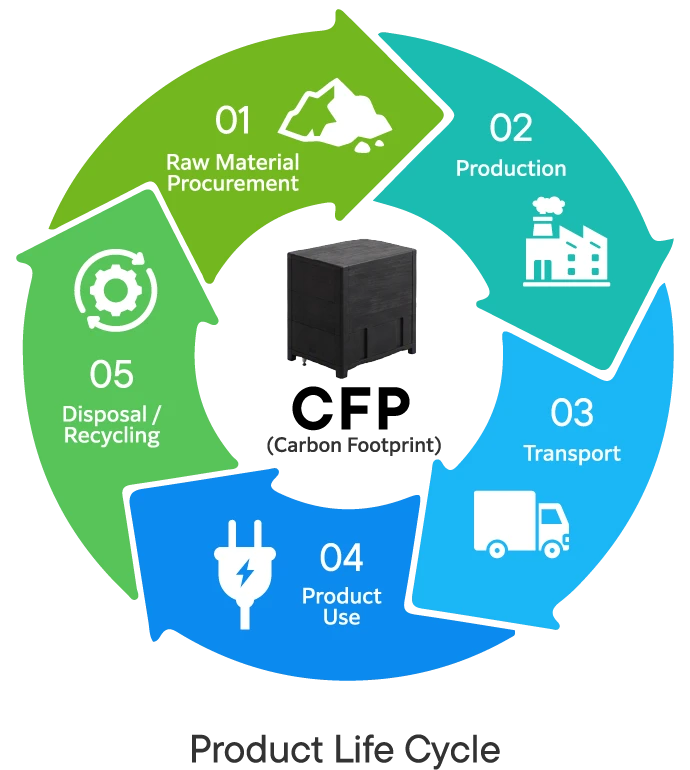
CFP Calculation Guide
Aratas is promoting the standardisation of rules for calculating product carbon footprints (CFP) as a foundation for understanding greenhouse gas emissions across the entire product life cycle and providing customers with relevant environmental information.
In developing these calculation rules, Aratas is establishing a common CFP Calculation Guide, taking into account international approaches such as ISO 14067:2018, Catena-X and the Pathfinder Framework published by WBCSD/PACT.
Since May 2024, Aratas has begun CFP calculations based on this guide, starting with the G9KB Series high-capacity power relays for new energy equipment. Going forward, Aratas will continue to expand the range of products covered by CFP calculations and enhance product environmental information in response to customer needs.